
The population of obese people in world increased from 10.5 crores in 1975 to 64.1 crores in 2014. In 1975 India ranked 19th in obesity in the world. Now we rank 5th in males and 3rd in females! There were 41.5 crore diabetics in the world in 2015. In India, prevalence of diabetes in the age group of people above 20 years is 8.7%.
Diabetes is a chronic, metabolic disease characterized by elevated levels of blood glucose (or blood sugar),
Read Morewhich leads over time to serious damage to the heart, blood vessels, eyes, kidneys and nerves. The most common is type 2 diabetes, usually in adults, which occurs when the body becomes resistant to insulin or doesn't make enough insulin. In the past 3 decades the prevalence of type 2 diabetes has risen dramatically in countries of all income levels.
When you eat sugar, your body secretes the hormone insulin to help move the sugar into your cells, where it’s used for energy. If you don’t burn off that sugar sufficiently, then over decades your cells become completely filled and cannot handle any more. The next time you eat sugar, insulin cannot force any more of it into your overflowing cells, so it spills out into the blood. Sugar travels in your blood in a form called glucose, and having too much of it—known as high blood glucose—is a primary symptom of type 2 diabetes.
When there’s too much glucose in the blood, insulin does not appear to be doing its usual job of moving the sugar into the cells. We then say that the body has become insulin resistant, but it’s not truly insulin’s fault. The primary problem is that the cells are overflowing with glucose. The high blood glucose is only part of the issue. Not only is there too much glucose in the blood, there’s too much glucose in all of the cells.
Think about packing a suitcase. At first, the clothes go into the empty suitcase without any trouble. Once the suitcase is full, however, it becomes difficult to jam in those last two T-shirts. You reach a point where you can’t close the suitcase. You could say the luggage appears to be resisting the clothes.
This is similar to the overflow phenomenon we see in our cells.
Management: Controls blood sugar with medicines or insulin but doesn’t heal the root cause.
Reversal: Focuses on metabolic healing — improving pancreas function, reducing fat in the liver and cells, and enabling natural insulin regulation.
Through integrated treatment, diabetes reversal is achieved without harmful side effects by restoring the body’s internal balance.
Insulin is a chemical substance scientifically termed as hormone from a gland called pancreas in your body. It is secreted in two different ways. One is called as baseline secretion; in which pancreas secrete 18 to 32 units of insulin throughout the day. This secretion cannot be stopped as it is essential for survival.
The other method of insulin secretion depends on food intake. Every time you eat insulin is secreted. It is expected that out of your total insulin requirement, half should come as baseline secretion and half from secretion in response to eating episodes.
Whatever you eat, insulin is secreted. It is documented that whether you take less food or more a similar amount of insulin is secreted every time. This we label as individual ‘measure’ of insulin which is person specific. It can be 2 units for one and 12 units for the other.
Once insulin is secreted or your measure gets emptied, it takes 55 minutes to refill it. Hence if you eat up to 55 minutes, insulin will be secreted only once. If you continue eating more than 55 minutes, then for every 55 minutes slot you will secrete insulin.
Frequent eating throughout the day can lead to repeated insulin secretion, which may contribute to insulin resistance, obesity, and metabolic disorders over time.
Specialized care programs
Get expert guidance today
Insulin is a conserving hormone which is responsible for energy storage and processes of synthesis in our body. Every time you eat insulin is secreted. It takes care of the end products of digestion of foods that you consume.
Surprisingly, though you eat dozens of food items, the end products are only three: glucose from carbohydrates, amino acids from proteins and fatty acids from fats.
On an average we need energy to the tune of 2000 calories per day. 1gm glucose / 1 gm protein gives 4 calories and 1 gm fatty acids give 9 calories.
The cells of the body can use glucose or fatty acids for energy. The trillions of cells in the body except cells from organ like brain are happy burning fatty acids. Brain cells have preference for glucose.
Glucose from the blood can not directly enter the cells as there is a lock on each cell, technically called insulin receptor. For glucose to enter the cells, insulin must open the lock of insulin receptors. Then only cells can get glucose.
Brain cells are again exception to this as they can directly take glucose from the blood. The first function of insulin is to allow the entry of glucose in cells. Cells then utilize glucose and perform their functions.
If there is some more glucose in blood, it is converted to a substance called glycogen in liver and muscles under the influence of insulin. Generally an adult would have 100gm of glycogen reserve in liver.
If there is still more glucose in blood, then insulin converts this into fatty acids and stores in body as fats! Insulin converts amino acids into useful proteins and also stores fatty acids as fats in body.
Thus it is a conserving hormone responsible for synthesis in the body. Insulin acts a switch to shuffle between use of glucose or fatty acids by the body. If high, body uses glucose and if low, body uses fatty acids as fuel. This is called as day cycle and night cycle in physiology.
Insulin not only controls blood sugar but also decides whether the body stores energy or burns fat for fuel. Balanced insulin function is essential for metabolic health and disease prevention.
Excess glucose is stored as glycogen in the liver and muscles.
Additional glucose gets converted into fatty acids and stored as fat.
Insulin helps the body switch between glucose and fat burning.
HYPERGLYCEMIA, OR HIGH blood glucose, characterizes all forms of diabetes. When blood glucose levels rise above the kidney’s ability to reabsorb the glucose (the renal threshold), it spills over into the urine, causing frequent, excessive urination and severe thirst.
The chronic loss of glucose may lead to rapid weight loss and also stimulate the appetite.
Early recognition of diabetes symptoms and timely lifestyle correction can help prevent complications and improve overall metabolic health naturally.
HEMOGLOBIN IS A protein found inside red blood cells that carries oxygen to the entire body. Over the average three-month lifespan of a red blood cell, glucose molecules attach to the hemoglobin in proportion to the prevailing blood glucose levels. The amount of glucose attached to the hemoglobin can be measured with a simple blood test called the hemoglobin A1C. The A1C thus reflects the body’s average level of blood glucose over three months.
HbA1C up to 5.6 is regarded as normal. From 5.7 to 6.4 it is labelled as prediabetes and after 6.5 it is called as diabetes.
Some other tests are:
Fasting insulin in healthy nondiabetic person should be near zero or at least below 6.
This measures this peptide in blood or urine to accurately determine how much natural insulin the body is producing.
Used to predict future cardiovascular events and monitor chronic inflammation related to obesity, diabetes, or metabolic syndrome.
The albumin-to-creatinine ratio (ACR) is the preferred method for measuring microalbumin levels.
This is a group of blood tests that measure enzymes, proteins, and bilirubin to evaluate liver health, diagnose diseases (like hepatitis, fatty liver, cirrhosis), and monitor damage.
Measures kidney efficiency in removing waste (creatinine, urea, uric acid) and balancing electrolytes (sodium, potassium, calcium).
It is a blood test, usually requiring 8–12 hours of fasting, that measures cholesterol and triglyceride levels to assess cardiovascular risk.
People with diabetes often have lower magnesium levels due to increased urinary loss, medications and stress hormones.
(R/M) test is a non-invasive, three-part diagnostic analysis (physical, chemical, microscopic) used to detect kidney disease, urinary tract infections (UTIs), liver issues, and diabetes.
It checks for parameters like color, pH, protein, glucose, cells and casts.
These are acids produced by the liver when breaking down fat for energy, typically when glucose is scarce.
While low levels are normal and benefits during fasting or dieting, high concentrations can make the blood too acidic, causing life-threatening Diabetic Ketoacidosis (DKA).
Certain organs, such as the eyes, kidneys, and nerves, are mostly supplied by small blood vessels. Damage to these small blood vessels results in the visual problems, chronic kidney disease, and nerve damage typically seen in patients with long-standing diabetes. Collectively, these are called micro vascular diseases.
Damage to small blood vessels can silently affect vision, kidney function, and nerve health over time.
Other organs, such as the heart, brain, and legs, are perfused by large blood vessels. Damage to larger blood vessels results in narrowing called atherosclerotic plaque. When this plaque ruptures, it triggers the inflammation and blood clots that cause heart attacks, strokes, and gangrene of the legs. Together, these are known as macro vascular diseases.
Macro vascular complications are among the leading causes of disability and cardiovascular problems in diabetes patients.
Beyond the vascular diseases are many other complications, including skin conditions, fatty liver disease, infections, polycystic ovarian syndrome, Alzheimer’s disease, and cancer.
Raised level of insulin, technically called as hyperinsulinemia, is responsible for many deleterious effects on our body. There are thousands of research articles published in medical journals that document these effects.
These include hypertension, obesity, hyperlipidemia and importantly insulin resistance.
Persistent insulin resistance can gradually lead to Type 2 or maturity onset diabetes mellitus.
Insulin resistance then results into type 2 or maturity onset diabetes mellitus.
When insulin level goes down then first glucose from blood is used by cells for energy. Then glycogen is broken down to get energy. Then your fats are used for energy purpose.
When insulin decreases, the body first starts utilizing glucose available in the blood to supply energy to the cells.
After blood glucose gets utilized, stored glycogen from the liver and muscles is broken down to provide additional energy.
Then your fats are used for energy purpose. This is the stage where the body starts using stored fat as fuel.
One must understand that to use fats for energy one has only one option and that is to reduce insulin level in the body. This can be done not by eating less but by eating less frequently!
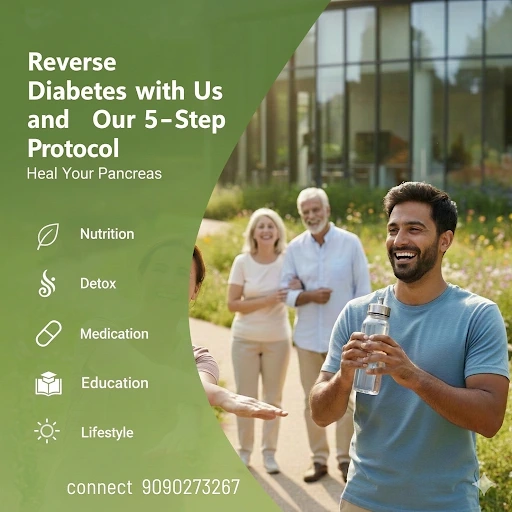
The IDR plan is built upon five core components that work together to promote healing and health.
A low glycemic load (LGL) diet is the cornerstone, emphasizing the avoidance of processed foods and high-sugar items.
Natural therapies are used for detoxification, with a specific focus on cleansing the internal & external organs. This helps remove toxins that may interfere with bodily functions.
This includes practices like meditation and yoga to align with the body’s circadian rhythm.
This involves specific medical tests, using proven supplements, and a careful process of tapering down medication.
Crucial part of this plan is gaining a deep understanding of diabetes, including “The Famous Two Theories”, the working principles of allopathic diabetic medicines and the various stages of diabetes.
This structured treatment plan is designed to guide the reversal process effectively.
Motto: Reduce inflammation, tone up the body, activate muscles and managing stress.
This phase includes gentle movements like Sukshma vyam, breathing exercises. Meditation focuses on healing the gut, activating the 7 energy points, mitochondrial function, healing the pancreas, healing past trauma, emotional blockage, negetive believes. Forgive & forget and Re-built positive relation.
✓ Consult Doctor
Motto: Clean up toxins, stop inflammation, activate the pancreas, and rebuild gut flora. Ketosis & Rehydration.
Motto: Increase muscle fiber, glucose handling capacity, and calorie intake.
Motto: The primary goal is to pass the Oral Glucose Tolerance Test (OGTT) and maintain rest of the life.
If you pass the tests, you will follow a “freedom diet” for rest of the life.
The IDR Program combines nutrition, detoxification, mindful lifestyle practices, medical guidance, and education to help restore the body’s natural balance and support long-term diabetes reversal safely and effectively.
High amount of insulin in blood is the main culprit.
It totally depends on your health condition and should be suggested by your doctor.
SGLT2 inhibitors help the body get rid of excess glucose through urine. UTI is common with this class of medicine. Long-term use may cause kidney issues.
It’s a process to improve your pancreas, regenerate β-cells, improve insulin sensitivity and manage stress. Generally, it takes 3 months to 1 year depending on your body type, duration of diabetes, your effort, and environmental factors.
Yes, this process is very crucial to manage stress, produce happy hormones, detox the body and reduce insulin resistance.
Diabetes medicines majorly work on the pancreas and can build insulin resistance in the body over time. Most medicines are developed based on the old theory that diabetes is only due to shortage of insulin and high blood sugar.
It’s a classic symptom of insulin resistance. Every adult weighing 65 Kg has approximately 13 Kg of fat in the body, which equals about 1,20,000 calories of stored energy. On average, we need only 2000 calories per day. So even if you don’t eat, your body has enough reserves. More details – consult us.
Nowadays, milk contains a lot of antibiotics, Insulin-like Growth Factor (IGF), antioxidants, antibacterial drugs, sheep offal and other chemicals.
High sugar foods, packed foods, processed foods, deep-fried foods, street foods, and high GI foods.
The best test is the Oral Glucose Tolerance Test (OGTT). It confirms your body’s glucose handling capacity. If you pass the test, it indicates diabetes reversal / remission.
Other supportive tests: C-peptide test, HOMA-IR test, and HbA1c.
Diabetes reversal usually means remission. With our Integrated 5-step plan, you can reverse your blood sugar problem for years, but regular medical follow-up is essential.
Not necessarily. Portion control and choosing low-GI varieties of fruits can allow you to include them in moderation. Rice can also be allowed depending on your health condition.
Genetics play a role, but lifestyle factors such as diet, exercise, and stress are equally important in triggering diabetes.
Not always. Some patients require insulin, while others can manage with diet, exercise, and medication. Our reversal programs aim to reduce or eliminate this dependency.
Yes. Stress hormones like cortisol can increase insulin resistance and raise blood sugar levels. Meditation is one of the best ways to handle stress and anxiety.
Body prefers to burn glucose and fatty acids for energy. Proteins are precious — losing more than one kilogram of protein from body stores can be life-threatening. Muscles (made of proteins) are used for energy only when other sources are completely depleted, which usually happens only during prolonged starvation.
Step-1: Fill up the form and submit it to us.
Step-2: Complete the tests after free consultation.
Step-3: Deposit the program fee and get a one-to-one call with the doctor.
Now you are Registered!
Ready to start your health journey?
Click Here to Register
Call / WhatsApp: 9090273267


